


ABOUT FAÇADES & FORTRESSES
Reading the Architectural Language of Helsinki
To truly understand the architecture that shaped Helsinki, look to each façade, square, and shoreline. Each reveals something about its cultural transformation, offering insights into how politics, society, and geography have shaped its uniqueness.
Our approach to Helsinki's Anthro-Architecture
Our tours rely on in-depth historical research, ethnography, long-term qualitative fieldwork (participant observation), and intensive interviews with independent and city architects and planners, building-site supervisors, office workers, and inhabitants.
Helsinki is filled with boundaries, thresholds, and spatial layouts that only the inhabitants themselves can see and understand. These spaces have shaped societal structure, identity, and architecture.
To demonstrate exactly how anthro-architecture works in a complex, heavily industrialised society, such as Helsinki, here are two real-world case studies that show how analysing human behaviour and social intentions completely alters architectural design.

Case Study#1 Hanasaari Power Plant A
Architect: Vera Rosendal
Photo Credit: Helen Oy
Case Study#1: Classic "form follows function," the Hanasaari Power Plant A
Architect: Vera Rosendal
When World War II ended, Finland was forced to cede 12% of its territory to the Soviet Union. The relocation timeline was brutal: the population had just ten days to pack up and move west. This forced 420,000 Finns to clamber onto whatever transport they could find. Viipuri alone had to evacuate 75,000 residents, many with a mere 24 hours’ notice.
Carrying only what they could fit into suitcases, ten of thousands of these refugees poured into Helsinki desperate for food, housing, and work. At the same time, tens of thousands of demobilised front-line soldiers flooded the capital looking for the exact same things.
The impact on Helsinki’s population was immediate and overwhelming:
-
1945: 276,000 residents
-
1946: 341,500 residents
-
1950: 368,500 residents
-
1960: 448,300 residents
-
1970: 522,200 residents
Despite severe material shortages and the immense social strain of housing everyone, Finland managed an incredible post-war recovery. Between 1945 and 1970, the country rapidly evolved from a war-torn, farming society into a modern, industrialised welfare state. Real GDP grew by an impressive 4.5% to 5% annually, and by 1961, unemployment was at an all-time low of just 0.70%.
This rapid industrial boom was fuelled by one main thing: heavy electrification.
Helsinki needed Hanasaari Power Plant A
To keep up with Helsinki’s rapidly expanding population and factories, city architect Vera Rosendal stepped in. Helsinki already had two power plants, but it desperately needed a third to handle the massive industrial peak building up for the 1960s. Despite being largely overlooked by modern history books, Rosendal pushed past severe supply shortages and daily arguments with labour crews to build Hanasaari Power Plant A.
First commissioned in 1960 and reaching full operation by 1967, Hanasaari Power Plant A became a classic example of mid-century industrial Functionalism, a design where visual form strictly followed mechanical purpose. It quickly became an unmistakable landmark on the waterfront, easily spotted from across the bay in Katajanokka.
When the plant was finally torn down between 2007 and 2008, the loss hit the local workers and residents hard. For decades, they had watched the building power the modernisation of their capital, and seeing it vanish from the skyline felt like the end of an era.

Case Study#2 "The Church that Vanished in Plain Sight"
Architect: Carl Ludvick Engel
Photo Credit: Façades
Case Study#2: "The Church that Vanished in Plain Sight"
Architect: Carl Ludwig Engel
While spending a day in Senate Square taking photographs and discussing our design theories, we overheard two tour guides explaining local landmarks to their groups. One of them offered an unexpected insight:
“Everyone wonders why Helsinki Cathedral is so large considering the size of the congregation in Helsinki during the mid-1800s. The truth is that the Russians built it on this scale simply because they wanted to project the ‘big’ power of the Russian Empire.”
The guides shared a laugh, their guests smiled in agreement, and the group moved onward.
The two of us looked at each other, shrugged, and continued taking our photographs, quietly debating the ideas behind their words. It is true that the cathedral appears unusually large if its sole purpose was to serve as a standard parish church for a modest local population. However, those tour guides completely missed the strategic anthro-architecture behind its massive scale.
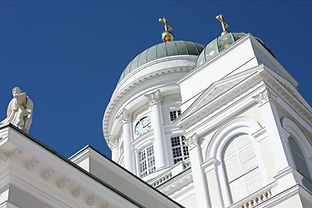
The cathedral sits atop an immense outcropping of granite. While construction crews used explosives to level the lower bedrock for Senate Square, Engel deliberately left the height of the church’s base platform largely untouched. As a result, it stands roughly 12 to 15 meters above the square. The building itself rises 62 meters from its floor terrace to the top of its central cross. Because the surrounding plaza sits elevated from the South Harbour, the towering green central dome reaches over 80 meters above sea level.
This positioning was entirely intentional. A compelling clue regarding its coastal visibility appears in a travelogue published in 1897:
“The first impressions on entering the Finnish harbour of Helsingfors were very pleasing; there was a certain indefinable charm about the scene as we passed in and out among the thickly-wooded islands, or dived between those strong but almost hidden fortifications [Suomenlinna] of which the Russians are so proud. Once having passed these impregnable mysteries, we found ourselves in more open water, and before us lay the town with its fine Russian church of red brick with rounded dome, the Finnish church of white stone, and several other handsome buildings denoting a place of importance and considerable beauty.”
— Ethel Tweedie, Through Finland in Carts (1897)
Tweedie’s account highlights the dual visual anchors confronting maritime travellers: the red-brick Uspenski Cathedral and the towering white stone of Helsinki Cathedral.
The second clue lies in the latter building’s original name, which has been largely obscured by shifting political climates. When Finland declared independence in 1917, the structure was renamed the “Great Church,” and in 1959 it officially became “Helsinki Cathedral.” But it’s true, original name tells a different story.
The Russian imperial court designed Senate Square to mirror the neoclassical grandeur of Saint Petersburg, earning the area the nickname “Little Saint Petersburg.” This wasn't done merely to display raw imperial dominance, but to demonstrate a deep, foundational investment in Helsinki as the new capital of the Autonomous Grand Duchy. The building was originally consecrated as Saint Nicholas’ Church, serving a deliberate dual purpose: to honour Tsar Nicholas I and to revere his patron saint, Saint Nicholas.
According to early Christian tradition, Nicholas was a protector of sailors and seafarers:
“Nicholas calmly prayed, and suddenly the wind ceased and the waves died down, to the wonder of the sailors, who feared shipwreck.”
Because Saint Nicholas is the patron saint of sailors and seafarers, the true utility of the building’s immense scale becomes clear. The church was elevated atop a granite outcrop so that its green central dome could pierce the maritime skyline. It served as a monumental beacon for sailors navigating the treacherous, rocky waters of the Helsinki Archipelago and the Kustaanmiekka Strait. The soaring white facade told sailors and seafarers that the capital was near, reassuring them against coastal shipwrecks. By aiming the bow of their vessels directly at the white church with its green dome, they could navigate safely into Helsinki’s South Harbour.
Modern urban planners still respect this historical relationship between architecture and the sea. Today, through tacit architectural agreement, city guidelines protect these specific maritime view corridors under the Sea Silhouette Policy (Merellinen silhuetti). Embedded within Helsinki’s Strategic Master Plan (Yleiskaava), the cathedral's green central dome is recognized as the defining focal point of the city’s coastal identity. These strict zoning laws ensure that no new high-rise structures in the central historic districts or adjacent coastal development zones may obstruct the view of the dome when approaching the city by sea. The historical beacon remains uninfringed, vanishing in plain sight as a mere tourist monument, while silently continuing to dictate the silhouette of the city.


Our Available Tours
Discover our range of available tours, each designed to give you a deeper, more engaging experience of Helsinki. Whether you’re drawn to its rich history, striking architecture, or hidden local gems, our tours offer something for every kind of explorer.


Elevate Your Helsinki Trip with FAÇADES & FORTRESSES
Expert-Led by Anthropologists & Historians
Our tours are guided by academically trained professionals who bring depth, accuracy, and real insight to every experience.
Authorised Suomenlinna Specialists
Official guides of the UNESCO-listed fortress, with expert knowledge of its construction, conflicts, and lasting impact on Helsinki.
Complex Stories, Clearly Told
We don’t oversimplify—our tours unpack Helsinki’s layered history in a way that’s engaging and easy to understand.
Honest, Objective Perspective
We present history with balance and integrity, avoiding myths and offering a thoughtful, evidence-based narrative.
Immersive & Transformative Experiences
Each tour is designed to go beyond surface-level sightseeing, creating a deeper connection to the city.
Memorable, Meaningful Journeys
Our tours are crafted to stay with you—authentic experiences that resonate long after you’ve left Helsinki.

Meet Your amazing Guides
Meet your guides—professional anthropologists and historians with a passion for bringing Helsinki’s past to life. With expert knowledge and engaging storytelling, they turn every tour into a deeper, more meaningful experience.


Read What Our Customers Say
"Phillip has a deep understanding of military strategy and local history. His ease in answering whatever question asked was a real pleasure."
Hannu Heikkinen
IT director: City of Helsinki
"Thank you so much for setting up such a fun and informative tour for us! It was perfectly tailored to what our group was looking for and had us discussing the history you shared afterwards! "
Michael Quarshie
CEO at Metabite.com
"Phillip knew the subject well and was able to deliver his knowledge to us. His output was clear and easily understandable. He was very convincing and we received a lot of information about the fortifications, their usage and history. "
Matti Jalonen
HSL
"A great three hours with a very knowledgeable guide, Phillip. I gained a lot of new information during the tour. And how Suomenlinna is connected to colourful phases of world history that I had never thought about, even though I have visited there many times. Absolutely the best tour of Suomenlinna ever. I highly recommend it to anyone who wants to dive deep into the history of Suomenlinna."
Sirkka-Liisa Virrankoski
HSL
"We had a wonderful tour with Phillip in windy Suomenlinna. Even though I have been there before, this time I learned so much about the history and architecture of the island.
Phillip tells about the history vividly and really knows what he is talking about. Magnificent three hours, definitely worth going!"
Laura Råman
HSL
"Phillip was the best guide you can ask for. He is brilliant, patient, passionate. He knew about history, military history, and even the history of rocks! He even made me cry out of emotion. I couldn’t recommend him more"
Judith Portier
Director: Studio Overall
"Phillip and Ilona were great guides. I'm a former guide myself and I know what it takes to have that much energy and knowledge. I'd been to Suomenlinna before and I thought I knew everything about the place, they taught me the proper history of Suomenlinna and Helsinki. "
Regina de Doelder
Aerojet (retired)
"I really enjoyed my Helsinki city‑centre tour with Ilona!
Ilona’s commentary was clear, well‑structured and always had a great build‑up before sharing each story. That made so many facts and details really memorable.
She took us smoothly around central Helsinki, and her passion for the city shone through. The whole tour felt relaxed and interesting from start to finish.
I would definitely recommend her to anyone visiting Helsinki. "
Melody Wu


